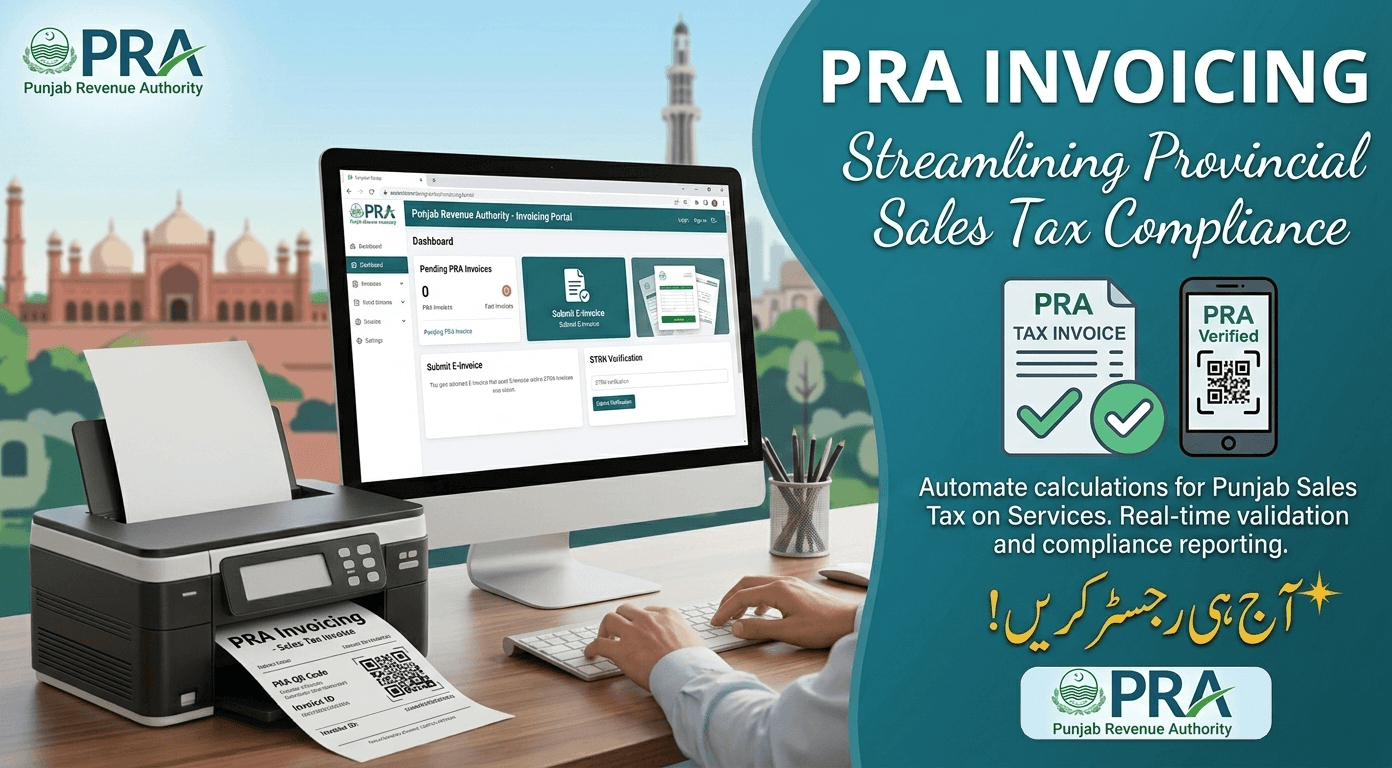
PRA E-Invoicing: Digital Tax Compliance for Services in Punjab
Tax reporting for service providers in Punjab has shifted from manual filings to mandatory digital integration. For businesses under the Punjab Revenue Authority (PRA), real-time invoice integration via the Electronic Invoice Monitoring System (EIMS) is now a critical regulatory requirement.
What is PRA E-Invoicing (EIMS)?
The PRA collects sales tax on services provided within the province. E-Invoicing is a framework where your Billing System or ERP connects directly to the PRA Fiscal Servers. This ensures that every service transaction is recorded by the Authority the moment the invoice is generated.
Integration Workflow
The process of integrating your service billing with the PRA is fully automated:
- API Connectivity: Your accounting or billing software communicates with the PRA’s Fiscal Server through a secure Application Programming Interface (API).
- Real-time Transmission: As soon as an invoice is saved in your system, the data is transmitted to the PRA portal for validation.
- Unique Fiscal ID & QR Code: The PRA server returns a unique Fiscal Invoice Number and a QR Code, which must be printed on the physical or digital invoice provided to the client.
- Automated Annexure-C: These transactions automatically populate your Monthly Sales Tax Return (Annexure-C), eliminating the need for manual data entry.
PRA integration is designed to eliminate undocumented service transactions and ensure that the provincial tax collected from customers is accurately reported.
Benefits of PRA Integration
Adopting the PRA e-invoicing system provides several operational and legal advantages:
- Simplified Tax Filing: Transaction data is pre-populated on the portal, removing the need for tedious manual entries at the end of the month.
- Legal Compliance: For notified service sectors (Hotels, IT, Couriers, etc.), EIMS integration is a statutory requirement under the Punjab Sales Tax on Services Act.
- Input Tax Verification: Businesses can verify and claim input tax credits more easily, as only system-verified invoices are eligible for adjustments.
- Audit Readiness: A digital trail of all service transactions makes your business transparent, significantly simplifying the process during a tax audit.
- Penalty Avoidance: Compliance protects the business from heavy fines, suspension of registration, or the risk of business premises being sealed.